
Bishop of Waterford warns of dangers of AI ‘revolution’ amid Pope’s encyclical

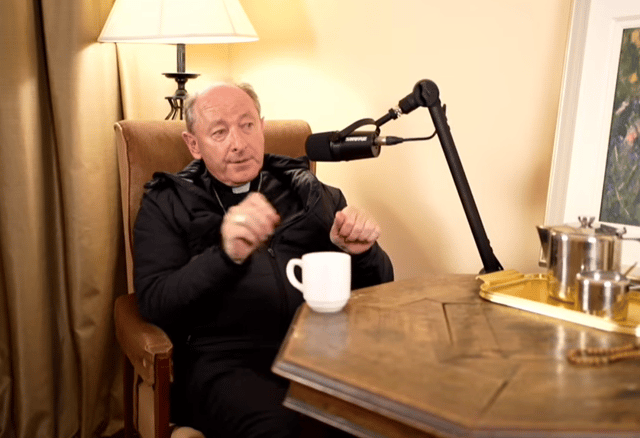

Bishop Cullinan was speaking on the latest episode of the Grásta Podcast on YouTube
The Bishop of Waterford and Lismore, Alphonsus Cullinan, has warned of the dangers of the artificial intelligence (AI) “revolution”.
Bishop Cullinan was speaking on the latest episode of the Grásta Podcast on YouTube.
He began by describing the background behind Pope Leo’s recent encyclical around the use of AI.
Bishop Cullinan said: “We are really delighted to be here as we welcome the first encyclical of our beloved Pope Leo. It’s Magnifica Humanitas and I have a little summary of it here.
“I’m not going to read it but I would really encourage you to when the document comes out. It’s literally hot off the press.
“It was launched in Rome and I suppose just to give a tiny bit of background. When Pope Leo took the name, people were intrigued, you know - ‘Leo? There hasn’t been a Leo since Leo XIII’. It was in the early 1900s when he died.”
He went on to outline an encyclical which was issued by Pope Leo XIII in 1891.
“Pope Leo issued in 1891 an encyclical called Rerum Novarum, of new things, basically. This was a man who was looking at the effects of the Industrial Revolution.
“He was looking around the world, he was very close to the people and he could see how the Industrial Revolution had changed human work and the way people work.
“So Pope Leo is looking at all this and he sees the dignity of the person being diminished, the dignity of human labour, the all embracing and all powerful role of capital and of money and that in the midst of all this, the human person and the human family is suffering.”
Bishop Cullinan continued by highlighting the similarities that encyclical had to the current Pope’s recent publication.
“Pope Leo IV is seeing a different kind of revolution, but certainly a revolution nonetheless, in artificial intelligence.
“The ERSI, a very important research institute in Ireland, has reckoned that AI could mean the loss or certainly the undermining of seven per cent of Irish jobs.
“That means 200,000 people losing their jobs through AI because AI can do secretarial work, design work, architectural work, production work. You know, you can get AI to do it.”
He recalled a recent visit to Dublin Airport, where he saw a robot serving people food in a restaurant.
“So again, Magnifica Humanitas dealing with the magnificence of the creation of humanity. It’s not about the Church being against this wonderful modern technology which of course is going to bring benefits also,” he added.
However, Bishop Cullinan warned that AI is also being used in modern warfare.
“Drones and AI creation are being used to wage war right now in our world, right now in Ukraine for example.
“I saw a film last week called ‘Shoulder to Shoulder’ about a group of men and women from Dublin who started up a charity to help people in Ukraine.
“They filmed their whole thing but while they were in a certain town, they saw the drones coming overhead.
“So they were sent by somebody hundreds of miles away, working out the technology and just dropping firebombs or whatever they do on innocent people.”
He continued by saying that Pope Leo confronts both the positive and negative impacts of AI in his encyclical.
“Pope Leo is confronting all of this in this document which I am really looking forward to reading.
“We’re encouraging our viewers to get it, to download it or buy it and read it and maybe to form with a group of friends and have a little reading session and see.
“It is real and you have the ERSI saying that this could possibly mean the loss of 200,000 jobs. That is hugely significant.”
Bishop Cullinan concluded by reiterating that whilst AI will have some benefits, people need to remain mindful of the human impact.
“Now I’m sure it will bring benefits, especially, I suppose, in the area of medicine and that is good.
“But at the end of the day, we have to be mindful of the centrality of the dignity of the human person, from conception to natural death and the human family.”